Loading IntelliForge…
Course Catalog
Learn at your own pace
Explore our courses and start your learning journey
₹99
The Claude Ecosystem Series · 10-Day Research Briefs
IF-RES-2026-150…159 · The Claude Ecosystem Series A 10-day research series on Anthropic's Claude — one capability a day, from choosing a model tier through to rolling Claude out across an enterprise. Models, Claude Code, the Agent SDK, MCP, Cowork, Claude in Chrome, Claude in Excel, Projects & Artifacts, the API platform, and enterprise admin, security and governance. Each brief covers what the capability actually does, where it fits in a real workflow, and where the line still has to be human. 10 research PDFs, grouped into 4 tracks. Read in order or jump to what you need. Lifetime access. Download and keep every PDF.
11 lessons6 enrolled
Free
Cursor & Its Ecosystem — From Autocomplete to an Agent Team
A 10-hour instructor-led intensive on Cursor and everything around it, worked continuously in one brownfield codebase. Covers the Cursor 3.0 Agents Window and the five editor surfaces, context engineering with the six surviving @-symbols and local Instant Grep indexing, rules that provably fire (.cursor/rules/*.mdc, the four activation types, AGENTS.md, Team Rules precedence), Plan mode with worktrees and verification loops, the two-pool model and cost picture including the Cursor Router, MCP servers and Skills, reviewing AI-written code with Bugbot and .cursor/BUGBOT.md, automation via the agent CLI, cloud agents and hooks in CI, team governance and security including what Privacy Mode does and does not guarantee, and a usage-analytics and cost model. Attendees leave with a working .cursor/ directory they built themselves. Carries a dated facts appendix the instructor re-verifies before each delivery.
12 lessons1 enrolled
₹299
30 AI Tools · Research Deep Dive Bundle
IF-RES-2026-017 · 30 AI Tools · Research Deep Dive Bundle 31 research PDFs — one landscape report plus a deep dive on each of 30 AI tools, written and published daily over 30 days. Every deep dive covers what the tool actually does, where it fits in a real workflow, what it costs, and where it falls down — written from hands-on use, not marketing pages. Grouped into 7 tracks: conversational assistants, research and data analysis, image and video, voice and meetings, writing and knowledge work, coding, and automation and agents. Read in any order. Lifetime access. Download and keep every PDF.
32 lessons1 enrolled
₹999
Python FastAPI + Fly.io — Ship a Production API in 10 Hours
From an empty folder to an authenticated, tested, cached, multi-region API running on *.fly.dev — with a rehearsed rollback plan. A 10-hour instructor-led intensive building one API continuously: FastAPI routing and dependency injection, async SQLModel against Fly Postgres, Pydantic v2 validation with custom exception handlers, OAuth2 password flow with pwdlib and PyJWT, an asyncio background checker with signed webhook delivery, pytest + httpx testing in GitHub Actions CI, per-Machine caching and Server-Sent Event streaming, a multi-region fly.toml deployment with secrets and a hand-executed rollback, and structured observability with a per-Machine-second cost model.
11 lessons0 enrolled
₹99999
FDP 01 — AI-Native Full-Stack Product Engineering (60-Hour Faculty Programme)
A 60-hour Faculty Development Programme for CS/IT faculty, across 24 build studios. Participants build and deploy Setu — a campus placement platform for 8,000 students and 400 recruiting companies whose matching spine is a language model — through product slicing and evals, React/Next.js, a compared backend layer (Node, Django, Spring Boot), SQL and NoSQL data modelling, the LLM layer, retrieval with vector databases, AI quality dashboards, and containerised deployment to AWS or Azure. Every slice must run end to end, every decision must survive a number, and every AI feature must state what it does when it is wrong. Each module ships a classroom-ready teaching kit with a lab, exam questions with marking schemes, a lecture outline, and a syllabus mapping, and every session carries a drill on reviewing AI-generated code.
66 lessons2 enrolled
₹99999
FDP 04 - Core AI Engineering (60-Hour Cohort)
The eight-module conversion course for working software engineers moving into AI engineering. Across 24 sessions learners build Triage — a support-ticket intelligence service — from a typed data pipeline and a hand-written training loop, through deep learning, NLP, computer vision and LLMs, to a monitored, autoscaled, red-teamed production deployment. Every session ends in an artifact a third party can verify in under ten minutes, and the capstone is a defence of every engineering decision made along the way.
58 lessons2 enrolled
₹99999
FDP 02 — AI-Native Full-Stack System Design (60-Hour Faculty Programme)
A 60-hour Faculty Development Programme for CS/IT faculty, across 24 design studios. Participants design Chalk — a learning platform for 42 affiliated colleges and 180,000 students — through distributed systems, microservices, API design, caching and queues, scalability, ML system design, serving generative AI, and observability. Every design decision must survive a number and name its failure, and every module ships a classroom-ready teaching kit with a lab, exam questions with marking schemes, a lecture outline, and a syllabus mapping. Includes a recurring drill on critiquing AI-generated architecture — now a core examination skill.
66 lessons2 enrolled
₹999
n8n Automation — Ship a Production Workflow System in 10 Hours
From an empty canvas to a self-hosted, queue-mode automation spine that survives a dead API, triages free text with a citation, and has a rehearsed restore. A 10-hour instructor-led intensive where every attendee builds one system — Relay, an inbound lead-operations spine — receiving live webhooks, enriching against a paginated rate-limited API without a 429, recovering failures into a dead-letter log with alerting, reusing one normalisation sub-workflow, triaging enquiries with an AI step that quotes its evidence and falls back to deterministic rules, and running on their own Docker Compose stack with a pinned encryption key. The capstone destroys the instance and restores it.
12 lessons0 enrolled
₹999
Next.js + Vercel — Ship a Production App in 10 Hours
From create-next-app to a cached, authenticated, streaming, observable product running on a production domain — with a rehearsed rollback plan. A 10-hour instructor-led intensive building one application continuously: App Router and the server/client boundary, Marketplace-provisioned Postgres, Next.js 16 Cache Components with use cache / cacheLife / cacheTag, validated and authorized Server Actions, Route Handlers with verified webhooks, proxy.ts and Clerk authentication, Core Web Vitals and dynamic OG images, Fluid Compute streaming with the Vercel AI Gateway, a prebuilt CI/CD pipeline with promote and rollback, and field observability with an Active-CPU cost model.
11 lessons1 enrolled
₹999
Exploring AI Roles: A Career Roadmap for 8th Semester Students
A 10-hour course designed for final-year (8th semester) engineering students to explore various career roles in Artificial Intelligence — including AI Engineer, ML Engineer, Data Scientist, NLP Engineer, Computer Vision Engineer, MLOps Engineer, AI Product Manager, Prompt Engineer, and AI Researcher. The course covers role responsibilities, required skills, tools, real-world projects, ethics, and a personalized career roadmap to help students choose and prepare for the right AI career path.
30 lessons0 enrolled
₹299
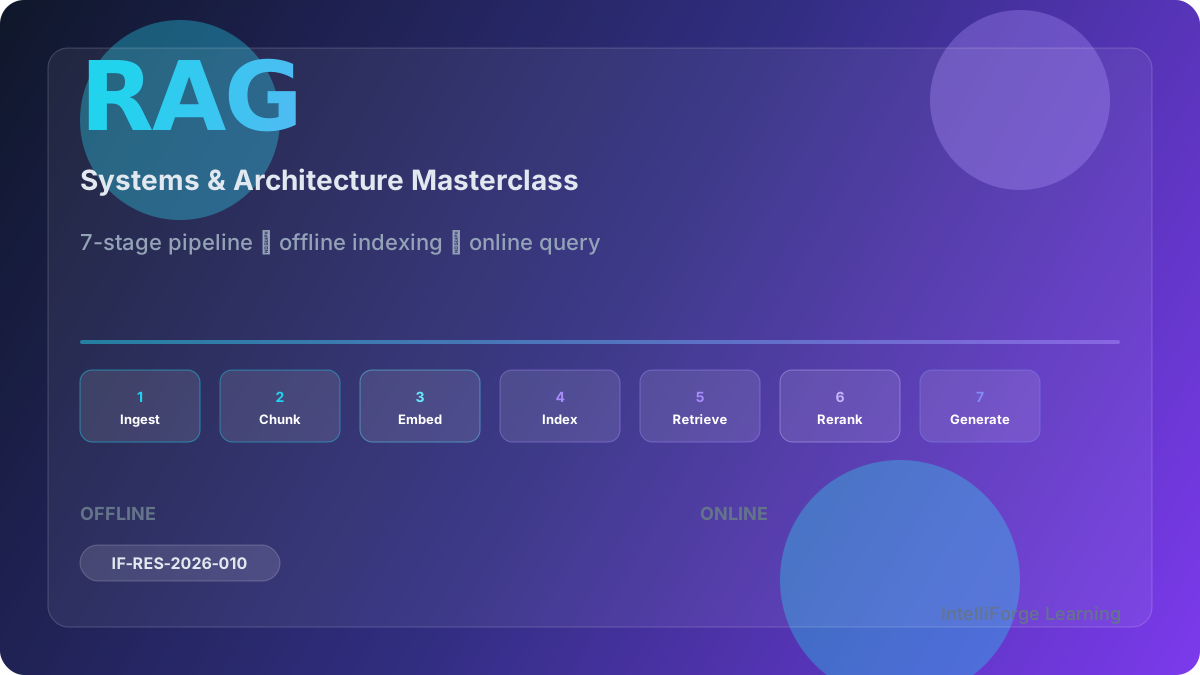
RAG Systems & Architecture Masterclass
From reading about RAG to shipping it — a 3-hour live masterclass for builders. Retrieval-Augmented Generation couples a generative language model with an external knowledge store so answers are grounded in retrieved evidence, not parametric memory alone. You'll walk the full pipeline — ingestion, chunking, embedding, indexing, retrieval, reranking, and grounded generation — plus architectural patterns (naive, advanced, modular, agentic, GraphRAG) and enterprise reference architecture. 3 hours live · recording included · ₹299 · Saturday 11 July · 5 PM–8 PM IST Hour 1 — Why RAG & the 7-stage pipeline Hour 2 — Patterns, design decisions & hands-on architecture Hour 3 — Enterprise RAG, evaluation, study library & live Q&A
11 lessons11 enrolled
₹49999
12-Week AI Upskill RoadMap
Don't build a portfolio project. Ship a real product. Ship a real product. Earn a verifiable credential. Live cohort bootcamp · Founder-taught · 15–18 hrs/week (Sat & Sun) · Cohort 1 starts 1 August 2026 · ₹49,999 early bird Build-alongside on live IntelliForge repos for top performers (capacity-limited). Verifiable credential at certs.intelliforge.tech — your name, cohort, shipped-product URL, and mentor score. Every session ends with one shipped artefact — not notes. By Week 12 you will have 12 real deliverables: code, live APIs, agents, deployed apps, and a personal brand. 12 sessions · 6 phases · 5 hiring-signal shipped systems · 36 curated free resource links. Phase 1 — AI Foundations: LLM fundamentals, SDKs, structured outputs, evals. Phase 2 — RAG & Data: embeddings, vector stores, production RAG pipelines. Phase 3 — Agents & Automation: ReAct, LangGraph, BullMQ async workflows. Phase 4 — Full-Stack AI: Next.js 14, Clerk, Prisma, Razorpay monetisation. Phase 5 — Production & DevOps: deployment, observability, security, cost governance. Phase 6 — Capstone & Career: ship an AI SaaS product, build your personal GTM.
86 lessons33 enrolled
Free
Skills, MCP & Benchmarking — 4-Hour Workshop
From consuming skills to shipping, connecting, and measuring them. A 4-hour intensive workshop where developers install Agent Skills, author a custom skill, configure Model Context Protocol (MCP) in Cursor, and run a benchmark harness to prove their skill works. Every attendee leaves with a Git-versioned skill, a working MCP connection, and a benchmark report.
5 lessons3 enrolled
Free
Building AI Agents
A curated, sequenced path from language-model foundations to production-grade agents. This is not a link dump. ~59 hand-picked resources are re-sequenced into the six stages that mirror how an engineer actually becomes productive with agents: understand the substrate, learn the control patterns, wire in tools and memory, then measure and operate. 7 modules · 30+ lessons · 3 quizzes · ~90 hours of curated study · Certificate on completion. OUTCOMES OVER CONSUMPTION — the success metric for this path is a shipped agent that passes an eval suite. Every stage names a concrete build target, so progress is measured by working software, not hours logged. Module 1 — Foundations: the language model, tokens, context window, and failure modes. Module 2 — Agent Patterns: the reason-act-observe loop, workflows vs agents, ReAct from scratch. Module 3 — Tools & Memory: MCP, retrieval-augmented generation, vector memory, browser/computer use. Module 4 — Evaluation & Operations: eval suites, accuracy, LLMOps, multi-agent orchestration. Module 5 — Foundational Papers: the primary sources behind modern agent design. Module 6 — Build Habit & Stay Current: hands-on repos and a signal-over-noise cadence. Best for engineers and bootcamp interns who want the fastest credible route to a shipped, evaluated agent.
31 lessons8 enrolled
₹14999
Claude Certified Architect — Foundations (CCA-F) Study Plan
IF-RES-2026-048 · Certification Action Plan · Anthropic CCA-F 2026 A complete 4-week preparation roadmap for the Anthropic Claude Certified Architect — Foundations exam — Anthropic's first official proctored technical certification. This is a systems design exam, not an AI literacy badge. Covers all five competency domains: D1 · Agentic Architecture & Orchestration (27%) D2 · Claude Code Configuration & Workflows (20%) D3 · Prompt Engineering & Structured Output (20%) D4 · Tool Design & MCP Integration (18%) D5 · Context Management & Reliability (15%) Week 1 — Foundations & Agentic Architecture (D1 + D5). Week 2 — Claude Code & Prompt Engineering (D2 + D3). Week 3 — Tool Design & MCP Integration (D4). Week 4 — Mock Exams & Weak-Area Remediation (all domains). Includes free study resources, community-verified exam intel, an exam-day checklist, and the Anthropic credential roadmap.
43 lessons1 enrolled

Free
AI for Beginners
Your first step into artificial intelligence — free, self-paced, and built for real life. Learn what AI actually is, how large language models work, and how to use tools like ChatGPT and Claude effectively. 5 modules · 17 lessons · 2 quizzes · ~4 hours · Certificate on completion. No coding required. No math degree needed. Just curiosity and a willingness to experiment. Module 1 — What Is AI? Core concepts, history, and the AI landscape today. Module 2 — Large Language Models: how ChatGPT-style AI thinks and where it breaks. Module 3 — Prompt Engineering: write prompts that get useful answers every time. Module 4 — AI at Work: productivity, creativity, research, and common pitfalls. Module 5 — Responsible AI & What's Next: ethics, privacy, and your learning path.
17 lessons3 enrolled

₹49
Python Programming for Absolute Beginners
Master Python programming from scratch. This comprehensive course covers everything from basic syntax to building real-world projects. Perfect for complete beginners with no prior coding experience.
25 lessons1 enrolled
₹14999
4-Week Product Management in the AI Era
IF-RES-2026-017 · Medium Track · AI Product Management For PMs, founders, and business leaders who need to ship AI products — without guessing what engineering should build. 4 weeks · 8 live sessions · 5 capstone briefs. Every session ends with a product artefact — PRD section, eval rubric, or launch plan. Phase 1 — AI Product Foundations: probabilistic products, build vs buy, PM role in the AI stack. Phase 2 — Discovery & Spec: user research, opportunity framing, PRDs with eval criteria and guardrails. Phase 3 — Trust, Metrics & GTM: AI UX patterns, quality metrics, cost models, safety, and launch. Phase 4 — Capstone Sprint: full product brief, eval plan, MVP roadmap, and Demo Day defence.
36 lessons4 enrolled
Free
Fresher Track Pre-Requisite Guide
IF-RES-2026-018 · Fresher Track · Pre-Requisite Guide Before Day 1: setup every tool, learn every foundation. Environment setup · Account creation · Free video tutorials · Week-by-week knowledge prerequisites · Day 1 readiness checklist. Complete this free course the week before Cohort 1 · Week 1 Session 1. Estimated setup time: ~4 hours for first-timers. Section 1 — Setup: install every tool and create every account before Session 1. Section 2 — Knowledge: free video and reading resources mapped to each programme week. Section 3 — Checklist: 19-item pre-flight check — tick every box before Day 1.
24 lessons26 enrolled
₹19999
4-Week AI Product Engineering Intensive
IF-RES-2026-016 · Medium Track · AI Product Engineering For engineers who've built their first LLM feature and want to ship a complete AI product people actually pay for. 4 weeks · 8 live sessions · 5 capstone briefs. Every session ends with a deployed artefact — not a demo. Phase 1 — Agents Done Right: tool calling, ReAct loops, memory, BullMQ async queues. Phase 2 — Full-Stack AI Products: Next.js 14, Vercel AI SDK, Clerk, Prisma, Razorpay. Phase 3 — Production & Cost: observability, security, model routing, rate limiting. Phase 4 — Capstone Sprint: ship a live AI SaaS with auth, payments, and observable production behaviour. Cohort: Saturday, 27 June 2026 – Friday, 31 July 2026 · 10:00 AM – 1:00 PM IST · 8 live sessions
36 lessons10 enrolled
₹299
Build Your First AI Agent in 3 Hours
From Zero to Deployed. Live. Today. — A single 3-hour intensive masterclass that takes Python developers from understanding LLMs to deploying a working AI agent on a public URL. Compressed Weeks 1–3 of the IntelliForge AI Engineer Bootcamp. Every attendee finishes with a deployed agent, a GitHub repo, three monetization paths, and a clear roadmap.
4 lessons3 enrolled
Free
IntelliForge Intern Onboarding Stack Curriculum
Trainer-ready 5-session onboarding curriculum for IntelliForge interns, with delivery guides, rubrics, assessment framework, expanded interview banks, and resource references.
11 lessons27 enrolled
Free
Software Engineering with Gen AI
A high-intensity, 3-hour free masterclass for MTech students and working professionals. Across three back-to-back sessions, attendees move from first AI-assisted code to watching a complete SaaS product get built and deployed live in a single afternoon.
3 lessons34 enrolled
₹999
AI Strategy for Business Leaders
A non-technical course for managers, founders, and product leaders. Learn to identify AI opportunities, assess ROI, manage AI projects, and lead organizational AI adoption — no coding required.
7 lessons0 enrolled
₹1499
RAG Systems for Real Business Problems
Build production-grade Retrieval-Augmented Generation pipelines. Cover vector databases, document chunking, reranking, and evaluation — applied to knowledge bases, customer support bots, and document Q&A systems.
7 lessons0 enrolled
₹1999
AI Agents & Agentic Workflows
Build autonomous AI agents using frameworks like LangGraph and AutoGen. Master tool use, memory, multi-agent orchestration, and human-in-the-loop patterns to ship production-ready agentic systems.
7 lessons0 enrolled
₹399
Digital Profile Creation
Learn how to create and optimize your professional digital profile for career growth.
2 lessons4 enrolled
Free
IntelliForge AI Training
Comprehensive AI training covering fundamentals, prompt engineering, agent development, automation, tools, workflow design, product development, and AI strategy.
4 lessons8 enrolled